Cheng Yuan (承远): meaning and pronunciation
承远
Chéng Yuǎn · Carrying a vision forward
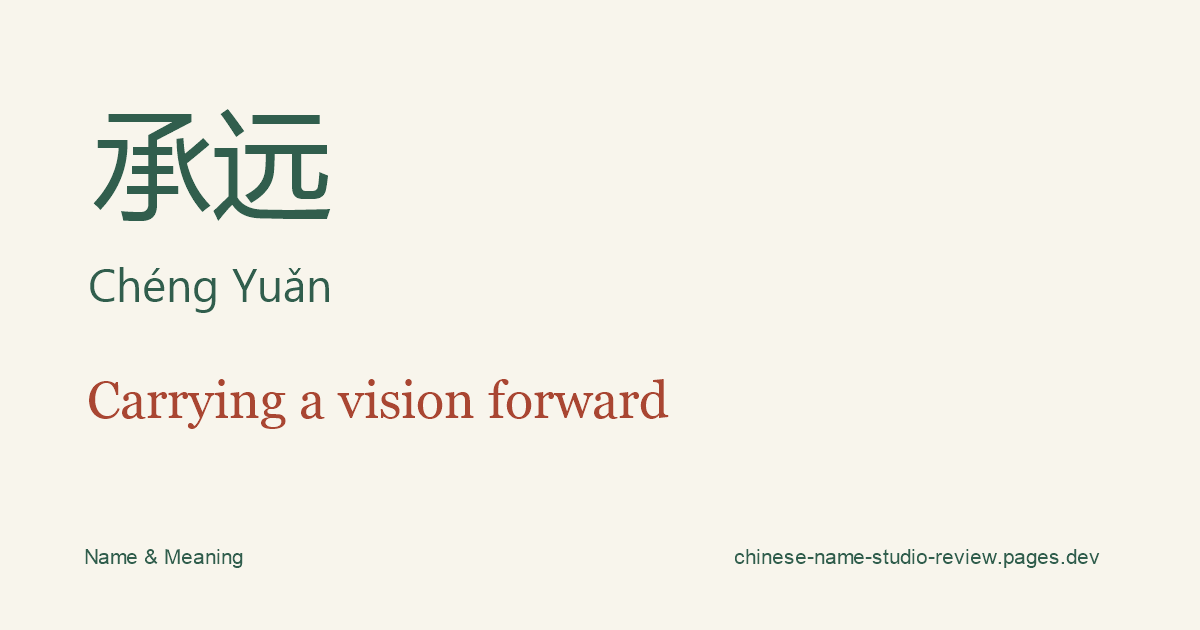
Something valued is carried onward beyond the nearest horizon. 承远 is a two-character given-name idea in our limited collection. This page explains its written characters, tone-marked Mandarin reading and the questions to ask before using it with a family name. It is cultural guidance, not an official translation or a prediction.
Reading the two characters
承 (Chéng) can mean to carry forward. In this pair, it provides the first part of an idea rather than an isolated slogan. 远 (Yuǎn) can mean far-reaching; a long view. Read the second character in relation to the first: 承 suggests receiving or continuing a responsibility; 远 stretches that motion outward. This is more active than the reflective 知远. Our short English gloss, “Carrying a vision forward,” is one interpretation of that relationship, not a word-for-word translation or a statement about who the bearer will become.
The written forms matter as much as a pleasing English definition. Copy the exact two characters from a reliable dictionary before putting them on a card or permanent object. If you are learning to handwrite them, use a dictionary with stroke-order diagrams; the finished printed character alone does not tell you the order of the strokes. Our writing guide explains how the given name sits after a family name.
How a family name changes it
Here are three illustrative complete names: 吴承远 (Wú Chéng Yuǎn); 沈承远 (Shěn Chéng Yuǎn); 陈承远 (Chén Chéng Yuǎn). The family name comes first; 承远 remains the two-character given name. The same pair can feel different after a short, rising or falling surname sound. These combinations are examples for listening and comparison, not certified recommendations for every dialect or social setting.
Read each example continuously. Then ask whether a speaker hears any unintended word at the surname–given-name boundary. We have not checked every regional variety or slang association and do not label any combination universally safe. If you already have a family name with personal significance, start with it rather than treating a generator's surname as an assigned identity. Our homophone guide offers a practical way to ask for a sound check.
Compare a nearby idea
知远 makes a useful comparison. 承远 places its emphasis on carrying a vision forward; 知远 uses a different relationship between characters. Comparing two complete names often tells you more than deciding from a single favorable dictionary meaning. Write both pairs down, listen to each with the same surname, and ask which sounds more like a name you would actually introduce.
For a wider shortlist, browse 柏言, 宇衡, 知远, 明澈, 思源. These share at least one imagery or feeling tag in our small collection, but their character meanings differ. The directory is a starting set of 48 ideas; a person who knows Chinese names can suggest options outside it.
The image behind this name
Something valued is carried onward beyond the nearest horizon. This is a way of remembering the pair, not a claim that the name has only one fixed reading. 承 means to carry onward; 远 points to a far-reaching future. The two characters are meant to be understood together, and different Mandarin-speaking readers may emphasize different shades of meaning. A dictionary can verify each character's common senses, while a conversation with a speaker can test whether the combined impression is natural in everyday use.
This name could suit a measured name about continuity and ambition. That is an aesthetic suggestion, not a rule about gender, age or personality. If the image interests you, try saying the complete name with your chosen surname before deciding. The strongest reason to keep a name is that you can explain why its characters and sound feel right to you.
Pronunciation and tone marks
The pinyin is Chéng Yuǎn. Chéng is a second-tone syllable, commonly described as rising; Yuǎn is third-tone, commonly described as dipping. Say each syllable with its mark and then put them back together at a natural speed. A tone mark is part of the Mandarin pronunciation, not decorative punctuation. English spelling habits are a poor guide to pinyin vowels and consonants, so listen to a native speaker when possible.
Do not assume that the two syllables will sound exactly the same in connected speech as when pronounced separately. Tone behavior, stress and the surname can change the impression of the whole name. Our browser Listen button is a useful first approximation, but its speech engine depends on the device. For an important use, ask someone to pronounce the complete written name aloud and repeat it back to them.
Questions before choosing
Is this an official translation of my English name?
No. This is a Chinese given-name suggestion. It has its own written characters and meaning; the tool uses only a limited sound hint from an English name.
Can the English gloss be taken literally?
No. “Carrying a vision forward” summarizes one plausible association. The individual characters and the whole name deserve separate reading.
Should I use it on a document or tattoo?
Only after checking the exact writing and complete pronunciation with a Mandarin speaker and, for official documents, the relevant legal rules. A creative suggestion does not change your legal name.
Ready for a different shortlist? Use your English name to explore three suggestions or return to all 48 names.